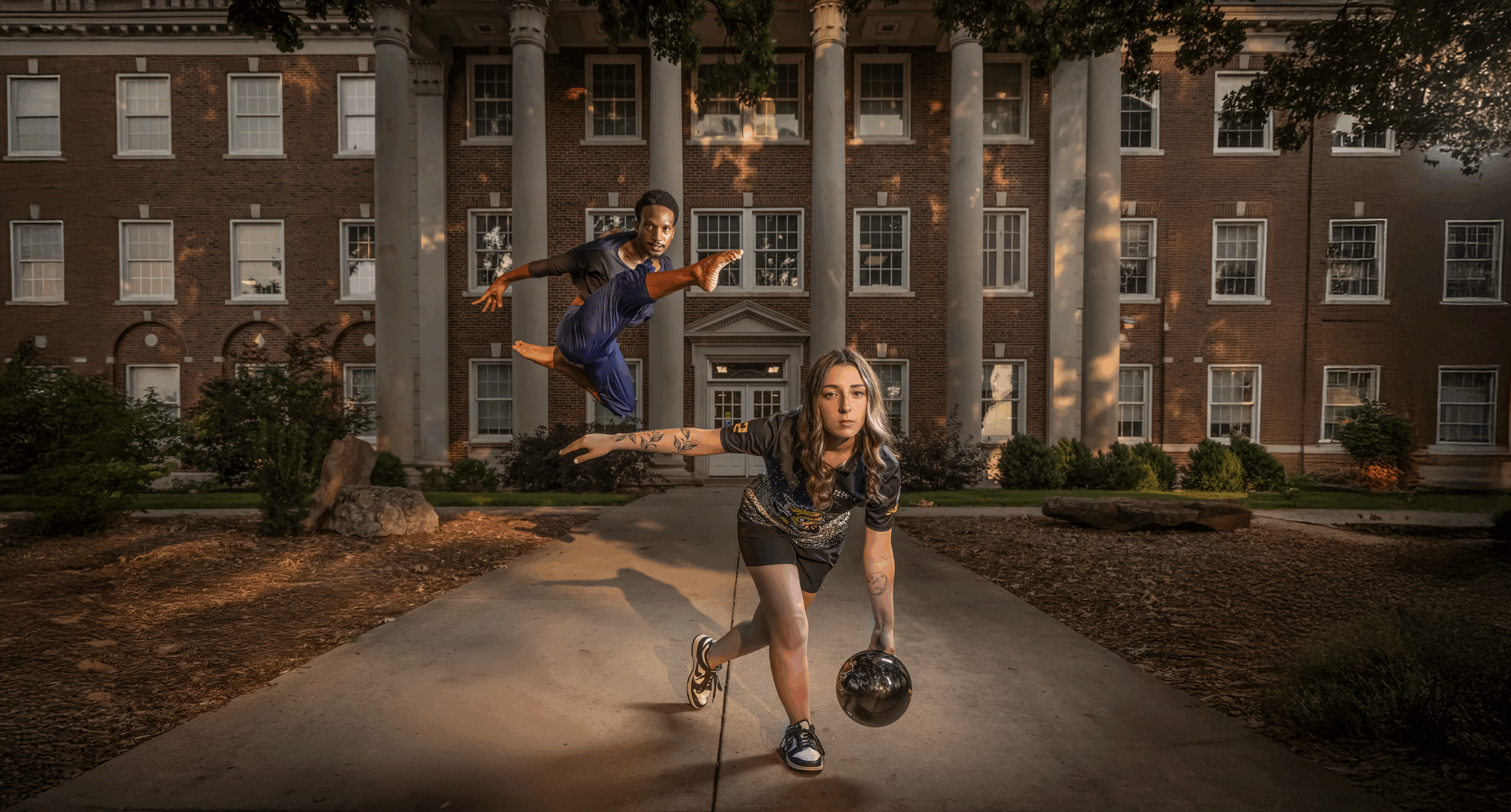
We Are 100

By Connie Kachel White
A century ago, Fairmount College (1895-1926) made the jump from private college to municipal university, becoming the University of Wichita (1926-1964). Today, three of Wichita State’s most lauded centers of learning track their beginnings back to that institutional leap and are celebrating centennial anniversaries all year long: the College of Education (CED), College of Fine Arts (CFA) and the W. Frank Barton School of Business.

College of Education
“For 100 years, we have prepared educators and professionals who strengthen schools and communities. That legacy continues to shape our work as we carry our commitment to learning and leadership into our next century.”
Dean Jennifer Friend
Oliver Troxel was the first dean of the College of Education (CED). He arrived on campus in 1926 to head a student body of some two dozen and a faculty of one other instructor — not counting Lambertus Hekhuis, professor and chair of Religious Education. With a bachelor’s degree from North Central College in Illinois and master’s and doctoral degrees from the University of Minnesota in hand, he also brought serious research experience as author of “Studies in School Finance” (1922) and co-author of “A Study of High School Record Forms” (1926), among other works of scholarship. He served as dean through 1929, structuring teacher-training programs and helping move the academic unit from its Congregational, private-school roots to a full-fledged municipal university college.
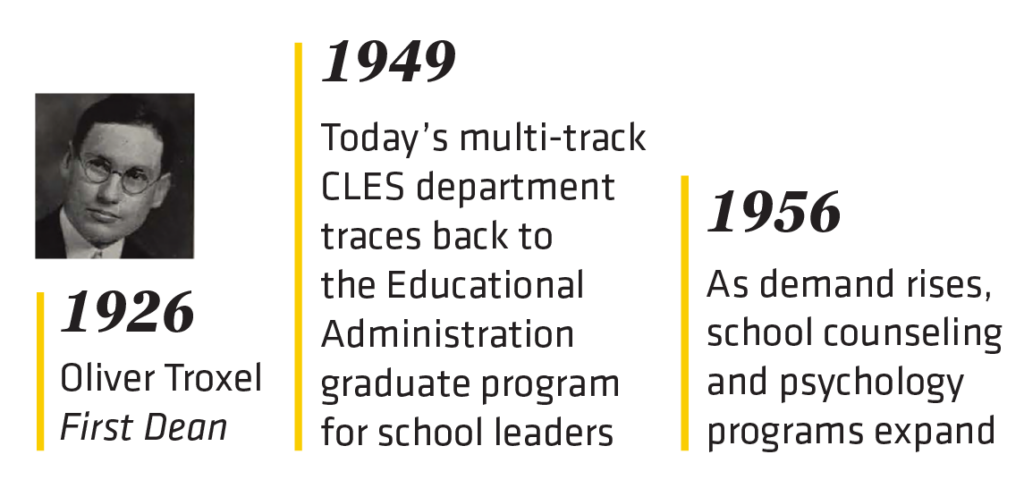
Jackson Powell was dean during the transition year of 1964 when the University of Wichita became Wichita State, officially entering the Kansas higher education system on July 1. That first academic year as a state entity, the CED had its highest enrollment total to date: 1,418. Like Troxel’s, Powell’s academic focus for the college he led from 1950-1966 was on preparing students for teaching careers to meet the ever-growing demand for educators. A year before he took up the deanship, the college expanded its offerings to include the Educational Administration graduate program. Powell continued this program expansion, adding school counseling and educational psychology in 1956, to mention just two additions to CED’s growing slate of degree programs in elementary and secondary education, school administration, special education, and student personnel. He was also the driving force behind the creation of the Corbin Education Center, which he envisioned as a building whose very architecture would help revolutionize teacher education.
Powell, who stepped into the role of dean at age 29, left the position after 16 years to become WSU’s vice president for academic affairs. Only his predecessor, Leslie Sipple, dean for two decades during the Great Depression and World War II, and his successor, Leonard Chaffee, who set up much of the college’s modern structure as dean from 1967-87, held the deanship longer. Maurine Fry (1988-93), Bill Williams (1994-96), Randy Ellsworth (1996-97), Jon Engelhardt (1997-2007), Sharon Iorio (2008-13) and Shirley Lefever (2013-21), each chalked up successes and left a mark on the advancement of the college and its students. Lefever, for instance, founded the Teacher Apprentice Program™ in 2017 in response to Kansas’ teacher shortage. TAP™ helped paraeducators become certified teachers while continuing to work. She was also a key supporter of the college’s name change in 2018 to the College of Applied Studies, as an unmistakable signifier of the importance of applied learning at WSU.
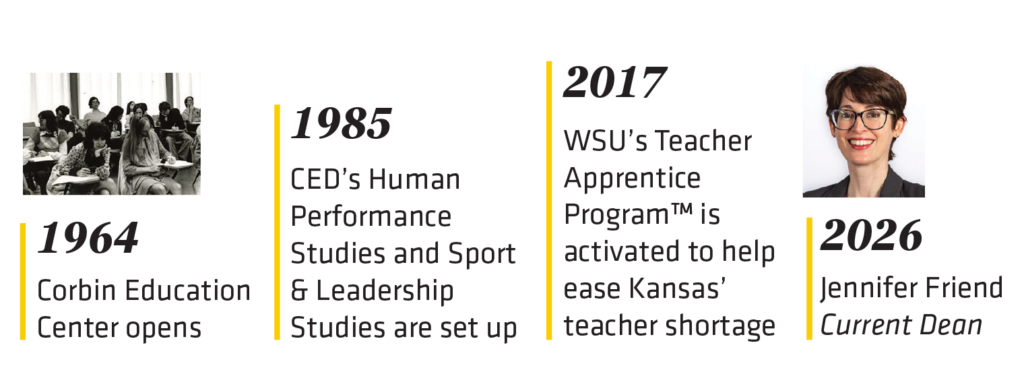
Jennifer Friend, who holds a Ph.D. in Urban Leadership and Policy Studies in Education from the University of Missouri, Kansas City, became the college’s 11th dean in 2023, joining WSU from Rockhurst University. Since taking the helm, she has continued efforts to broaden disciplines, expand degree programs (notably with the 2025 launch of the college’s first research-focused Ph.D. — in education and behavioral studies) and hold the college to its longstanding conviction that applied learning is the defining student experience at Wichita State.
Today, the college, which on March 1 went back to its original name as part of its centennial celebration, maintains for the benefit of its students more than 350 affiliation agreements with schools, clinics and community organizations, as well as such partnership initiatives as the Credit Union of America Teacher Licensure Test Fund. With three academic units dedicated to teaching, counseling, and human performance, the college serves nearly 2,400 students. Teacher education majors in the School of Teaching and Learning complete student teaching placements in Wichita Public Schools, the largest district in Kansas. Master’s degree students in Counseling, Educational Leadership, Educational and School Psychology (CLES) offer free mental health and play therapy services to the community through the WISE Clinic. Students in Sport and Leadership Studies gain real-world fluency through internships and partnerships with local and national organizations and connect with sports industry professionals at the annual Kansas Sport Summit, established in 2024. This April, Marc Farha ’86, co-CEO at ICON, a multinational sports and entertainment venue development company, was the keynote speaker at this CED centennial-year event.
Also in April, the college hosted a Centennial Open House at its Frank Lloyd Wright-designed campus home, a singular event in its year-long celebration. In mid-August, the college will name its 2026 CED Hall of Fame inductees — in honor of all alumni, faculty, donors and friends who’ve had a hand in writing curricula for these first 100 years.

College of Fine Arts
“Reaching this significant milestone is a testament to the dedication and passion of our faculty, staff, students, alumni and supporters. Our centennial year is not only a time to reflect on our achievements, but also an opportunity to energize our commitment to the arts and their essential role in society.”
Dean Marie Bukowski
Cited as “one of America’s seven great composers” in the 1927 Parnassus, Thurlow Lieurance was dean of the College of Fine Arts from 1926-1945. A pioneering composer profoundly fascinated by the indigenous cultures of North America, he hauled Edison recording paraphernalia to various reservations by wagon during the 1920s to record, transcribe and preserve Native American music. Deeply influenced by the melodies he heard, he composed many highly regarded works, including his internationally lauded 1913 masterpiece, “By the Waters of Minnetonka,” based on a Sioux song about star-crossed lovers. As dean, he used his professional artistry and years of fieldwork to structure Fairmount College’s music and art departments into a fully recognized degree-granting college. Early on, he had assistance from fellow faculty, including Elizabeth Sprague, a painter and founding chair of the art department, as well as George Wilner, who headed speech and theater from 1923-1960. Later, Clayton Henri Staples, who directed the art department from 1930-1950, developed the first MFA program in Kansas and one of the earliest in the country.
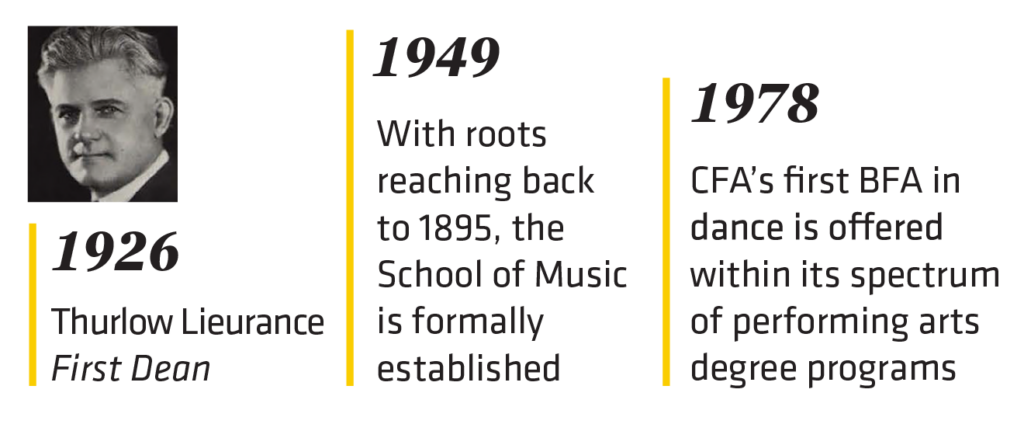
Walter Duerksen ’31/38 was a classically trained trombonist who led the college as dean from 1951 until he bowed out of the position in 1970, continuing to teach until his full retirement in 1972. He first joined his alma mater’s faculty as trombone instructor and director of concert and marching bands in 1932, a year after earning a bachelor’s degree in music education. In 1942, he was named chair of the music department and in 1949 became the first director of the School of Music, which he is noted for growing from 60 majors and nine faculty members to over 500 majors and 65 faculty by 1972. He was also key in mustering financial support and professional personnel for the Wichita Symphony Orchestra, organized in 1944. As dean of fine arts, he orchestrated the expansion of curricula that scored high-level accreditation for the college’s music, art and theater programs. He also oversaw planning for a new fine arts center on campus, which opened in 1956 and was later named in his honor.
After Lieurance and Duerksen, the line of deans (and interim deans) continued the college’s cross-disciplinary crescendo in students, faculty, degree programs, facilities, community arts involvement, and professional influence and reach. Music theorist Charles Spohn led the college from 1970-73, followed by pianist and clarinetist Gordon B. Terwilliger from 1974-85; theater educator Rhoda-Gale Pollack, 1986-92; trumpet professor Walter Myers, 1994-2002; and behavioral music researcher Steven Hedden, 2002-03. In 2004, operatic baritone Rodney Miller took on the role. Before retiring 19 years later, he set in motion the planning, partnerships and curricular innovation that established in 2019 the college’s fourth school, bringing together digital, visual, musical and performing arts within a single, comprehensive unit.
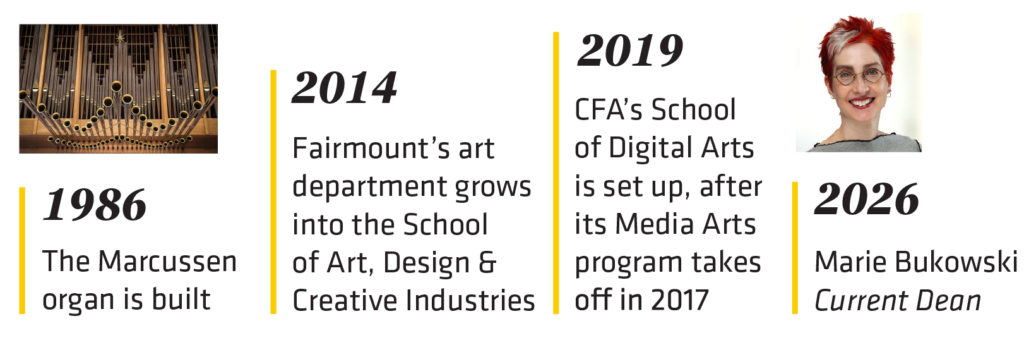
Today, the college comprises the School of Music, the School of Art, Design & Creative Industries, the School of Performing Arts and the School of Digital Arts, offering a diverse range of undergraduate and graduate programs, including professional degrees, specialized certificates and Kansas’ only nationally accredited dance program. With upwards of 20 areas of undergraduate study and some 15 distinct graduate degree concentrations, the college has over 120,000 square feet of visual arts space, as well as practice rooms and performance halls, including Duerksen Fine Arts Center, Wilner Auditorium, McKnight Art Center, Henrion Hall, Shocker Studios and Wiedemann Hall, home to the Marcussen organ, the first of its kind in North America. CFA also maintains scores of off-campus partnerships that benefit students and faculty, including collaborations with Somewhere Works for music programming, the Empty Bowls Wichita Initiative for ceramics and the City of Wichita for public art installations.
Marie Bukowski is the first visual artist to hold the deanship at WSU. A printmaker and painter known for integrating mathematical figures and concepts into her art, she arrived on campus in 2023 from Kent State, where she most recently was associate dean of graduate programs and faculty affairs. She holds an MFA in painting and printmaking from the University of Pennsylvania and a BFA in painting and German literature from Carnegie Mellon. At Wichita State, she has focused on the college’s creative and operational framework, its alignment with university-wide priorities — and its 100th anniversary celebration.
The slate of special events, including the upcoming 2026 Hall of Fame induction ceremony, celebrates present pursuits and accomplishments alongside the legacies of those who — like faculty composers Lieurance and Walter Mays, art scholar Mira Merriman, opera director George Gibson, printmakers David Bernard and John Boyd, percussionist and conductor J.C. Combs, actors and directors Wilner and Dick Welsbacher, and too many famed alumni to list — molded the college’s artistic identity. At its essence, Bukowski frames the centennial as a proof-of-concept: art matters.

School of Business
“For 100 years, the Barton School has not only been closely connected to the Wichita business community but the global community of business, as well. Our centennial year is a meaningful time for us to reflect on the effect our students, alumni, faculty and partners have made in these communities.”
Dean Larisa Genin
Frank A. Neff stepped in as the first dean of the College of Business Administration and Industry in 1926, after serving as vice president, registrar and head of Fairmount College’s department of business administration and economics. A graduate of Lafayette College in Pennsylvania and of Harvard, from which he received a master’s degree in political science and government, Neff came to Wichita in 1911 to teach political science and economics. As dean of business and industry, he centered the early college on cooperative education, with students alternating between classes and jobs. At this early stage of its development, engineering was the “and industry” part of the college’s name. Offices for the college were on the third floor of Jardine Hall. It was 1950 when Neff — who had completed a doctorate in economics and municipal finance from the University of Nebraska and authored Economic Doctrines (McGraw Hill, 1950) — stepped down as dean.
Kenneth Razak then took up the position, and a year later the college moved into Neff Hall,
named after Dean Neff and the first post-WWII building constructed on campus. William Nielander became dean in 1953, and two years later engineering split off to become a separate college. In 1957, Jack Heysinger was named dean. The 1958 Parnassus yearbook offers this snapshot: “Formerly composed of six departments, the college is now made up of four: accounting, administration, economics and secretarial training. In these four departments 250 courses are taught. The business building, Neff Hall, is a two-story modern structure with air-conditioning throughout.”
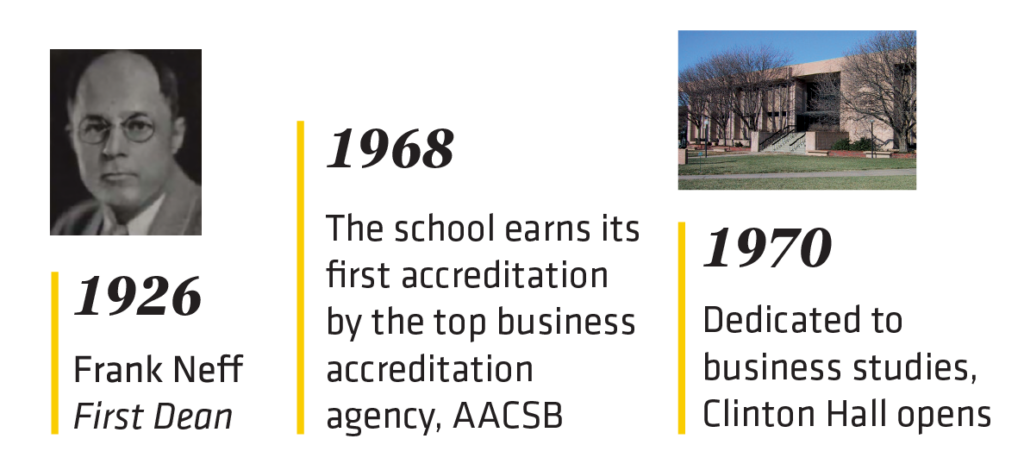
Fran Jabara led the college as dean from 1964 to 1971 during a time of robust
growth as the university transitioned from municipal to state status. In 1968, the college achieved its first accreditation by the American Assembly of Collegiate Schools of Business, the top national business accreditation agency, and — to deal with heavy increases in enrollment — moved into the newly opened Clinton Hall in 1970. In 1971, Jabara stepped away from the deanship, remaining as a faculty member and founding, in 1977, WSU’s Center for Entrepreneurship. A first workshop, “Entrepreneurship: Your Future in Business,” drew some 300 students, helping inspire a national movement to make entrepreneurship a key component of not only business education but all fields of study.
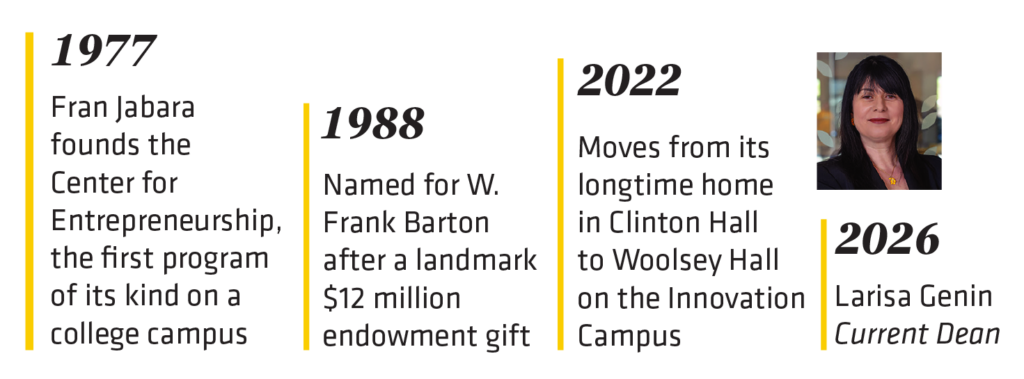
Lawrence McKibbin (1972–76), Douglas Sharp (1976–90), Malcolm Richards (1991–1993), Gerald Graham (1993–2000), John Beehler (2000–07), Douglas Hensler (2008–2013) and Anand Desai (2015–19), each dean advanced the college’s growing business education portfolio. During Sharp’s tenure, for instance, the college’s School of Accountancy was established (1981), ground was broken for Devlin Hall and named after entrepreneur and WSU alumnus Tom Devlin — making WSU one of the first universities in the world to dedicate a building solely to entrepreneurship education (1988) — and the college was named the W. Frank Barton School of Business in recognition of a landmark $12 million endowment gift from the co-founder of Rent-A-Center and his wife, Patsy (1988). Another landmark, the Koch Global Trading Center, opened in Clinton Hall in 2014, when James Jordan-Wagner was the interim dean. Other influential interim leaders include Cindy Claycomb ’79/91.
Today, the Barton School comprises four academic units — accountancy; management; economics and marketing; and finance, real estate and decision sciences — and is ranked among the top 1% of business schools worldwide, a distinction earned through its rare double AACSB accreditation in both business and accounting. The school is headed by Larisa Genin, who came to WSU in 2019 from Saint Mary’s College of California, where she served, among other roles, as associate dean for the School of Economics and Business Administration. In 2022, she oversaw the college’s move into Woolsey Hall on WSU’s Innovation Campus.
This year, Genin is stewarding a centennial calendar worthy of the milestone. On Feb. 21, the school launched its 100th anniversary celebration with a “Beyond” Hall of Fame gala that raised over $1,267,700 in support of student success. More than 300 alumni, business leaders, university officials and community and industry partners gathered to honor Paul Allen ’70, CEO of Allen, Gibbs & Houlik; Dan Carney ’53/04, co-founder of Pizza Hut; and Steve Feilmeier ’85, retired Koch CFO, for their professional success and individual dedication to service that extends well beyond the world of business. Then, on April 6, a delegation of Barton School students, faculty and alumni rang the NYSE closing bell, telling Wall Street, and the world, that a century in, the best may be yet to come.