Maximum Value
In 1904, F.B. Isely, who graduated in 1899 with a bachelor’s degree in biological sciences, penned a letter to the student editors of Parnassus, Fairmount College’s yearbook, detailing the formation and varied contributions of the Fairmount Debate League.
The school’s first graduating class, for which Isely sat as class president, incepted the debate league in the fall of 1896. By spring, the team had booked its first official debate, set for the second Friday in April 1897. Within just a few short years, wrote Isely, the program had cemented itself as a most essential facet of the student experience. “The benefits of the League to the student body are many. It brings about unity, enthusiasm and stimulates esprit de corps,” he wrote. “As individuals the contestants receive the maximum good.” With humor, he acknowledged that “only those that have been ‘thru the mill’ can appreciate the work involved” in the discipline, a truth which echoes across decades of debaters.
‘Thru the mill’
Today, WSU’s debate legacy is virtually inseparable from the name Quincalee Brown ’61/61. Coming from a heritage family of Shockers, Brown attended the University of Wichita and graduated with dual degrees in speech and English in 1961. She remembers fondly her time as a student on the debate team under Mel Moorhouse. “We won a couple of trophies, which was very exciting,” she says. “Nothing spectacular, but we had a presence in the Midwest.”
An exhibition tour through Pennsylvania introduced Brown to the University of Pittsburgh, where she attended after WU. She obtained a graduate assistantship and taught a few sections of speech while seeking a master’s degree in rhetoric and public address. After graduating with her master’s degree, she got a call from Les Blake, speech department chair, asking her to return to Wichita State as assistant debate coach. She accepted and would later become the team’s head coach, working with assistant coach Marvin Cox. “Marvin and I had a great rapport,” Brown says. “He liked doing all of the serious analysis required for the team, and I loved running the program: recruiting students, pairing kids together, taking raw talent and figuring out where they could be the most successful.”

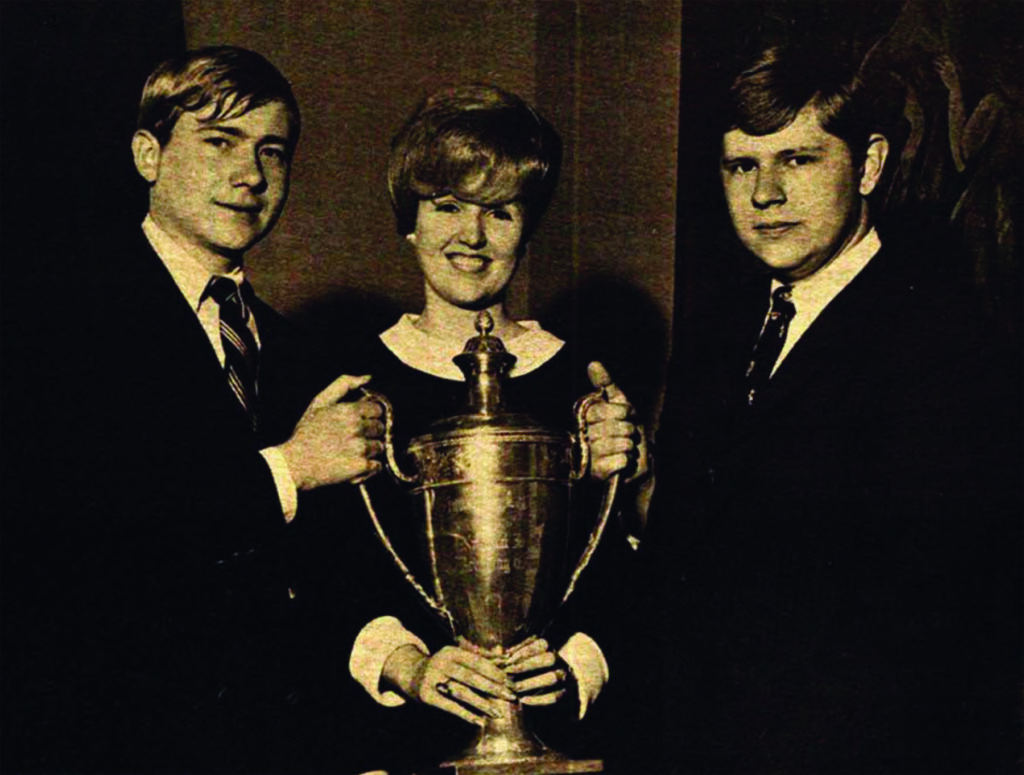
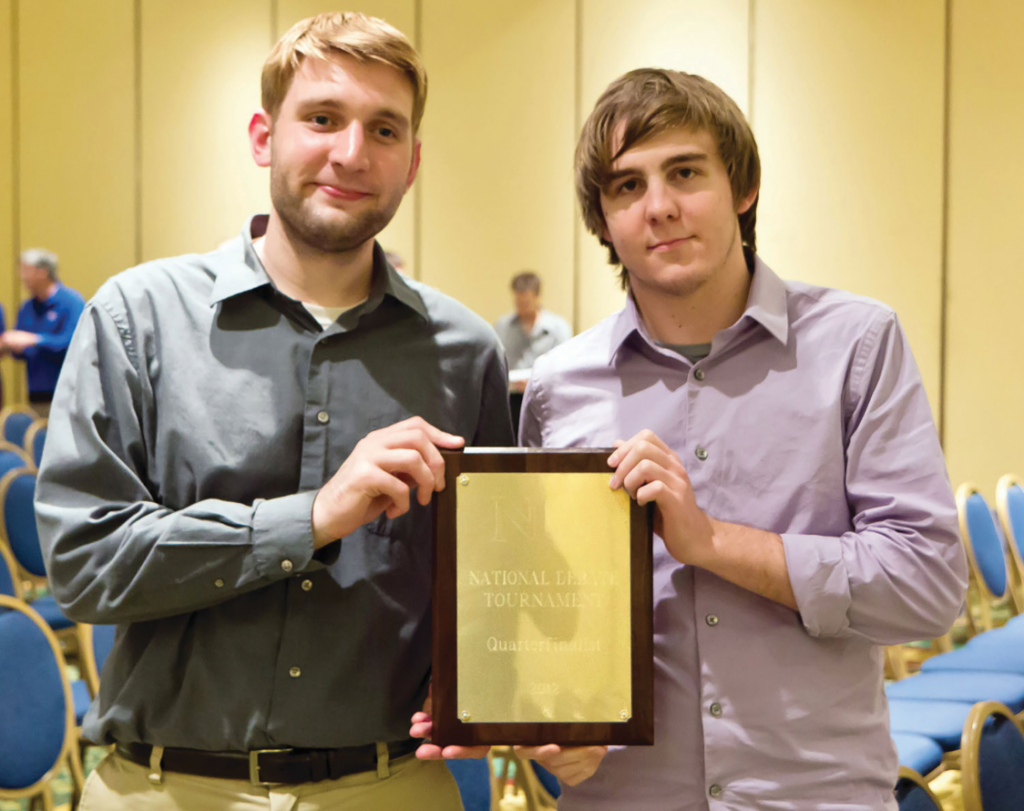
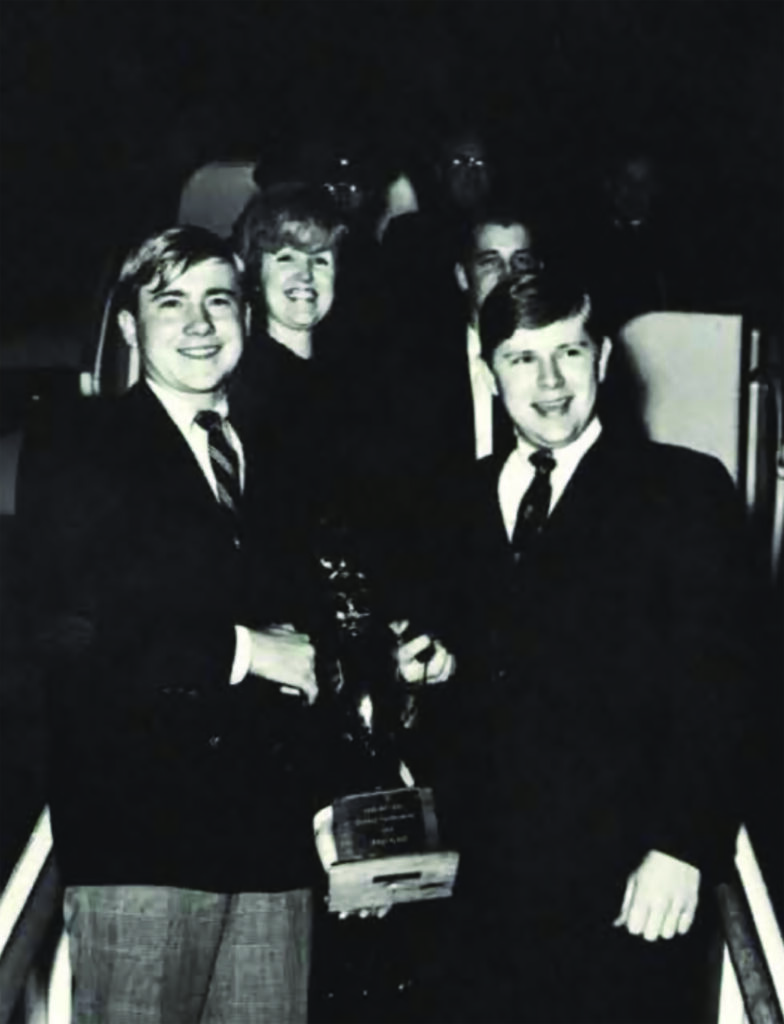
Brown coached some of the program’s best-known names, including Wanda (Graham) Sobieski ’69, one of the first female lawyers at a major law firm in Nashville, and Bill Balthrop ’67, who eventually became president of the National Communication Association and the American Forensic Association. Under her direction, Lee Thompson ’68 and Bob Shields ’68 defeated Butler University at the 22nd National Debate Tournament in 1968, the first team in the university’s history to take home the first-place trophy and the only one since. While no other WSU team has won the championship, seniors Brian Box ’12 and Matt Munday ’12/14 reached the final round of eight in NDT competition before losing to Gonzaga in 2012. Just last year, Marianne Griffith and Miguel Molina-Chavez were one win short of making it to the elimination rounds of the 79th NDT in Spokane, Washington.
After their 1968 victory, Brown coached the team one more year before going on to pursue her doctorate in communications and human relations at the University of Kansas. Her career blossomed after her doctoral studies, holding positions in local and federal government, as well as the American Association of University Women. She helped to found the Water Environment Research Foundation, now the Water Research Foundation, where she advocated for improvements in water-quality science and technology. Brown credits her debate experience, in part, with building the self-assurance to achieve so much throughout her professional career. “I actually think I may not have done any of this had it not been for my debate background,” she says. “It gives you confidence to stand up in front of a group of people, to think quickly on your feet and to organize your argument to persuade diverse audiences.”
The benefits are many
Phillip Samuels, assistant professor of communication studies and director of debate at WSU, sees that same confidence budding in the program’s current students. “At its core, debate teaches students how to research complex problems, evaluate competing forms of evidence and construct persuasive arguments,” Samuels says, evoking Isely’s assurance that the benefits of debate are, in fact, many. “These are skills that translate directly into careers in law, public policy, education, journalism, business — practically any field you can think of. I consider it one of the most intensive, and deeply rewarding, forms of experiential learning.” The proof is in the students themselves. Under Samuels’ direction, the Shockers have consistently qualified for the two largest national tournaments, the National Debate Tournament and the Cross Examination Debate Association National Tournament, clearing teams into the top echelon of competitors at each.
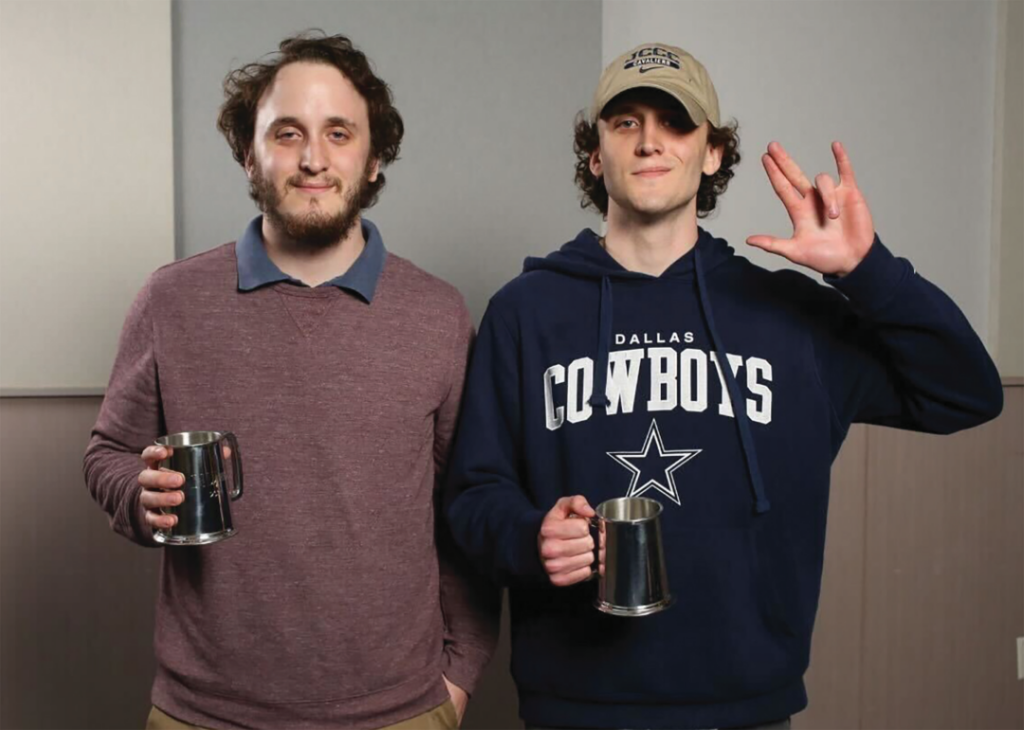
Thomas Babcock ’24, who is finishing up his studies for a master’s degree in communication this spring, serves as the program’s assistant coach. For him, graduate school at WSU was a natural evolution from his undergraduate experience as a policy debater. “Entering graduate school, I wasn’t worried about learning how to read academic articles or engage in high level research, as that had already been expected of me during my years of collegiate debate,” he says. That training enabled him to jump into research projects, resulting in both published articles and opportunities to present at national academic conferences. As undergraduates, Babcock and his twin, Travis ’24, were a dynamic debate-team duo who helped WSU achieve top-32 finishes in four NDT competitions, including placing 12th in the nation in 2024.
Samuels is pleased to note how debate alumni are helping strengthen school programs across Kansas. This includes Babcock, assistant director of speech and debate at Newton High School, who adds, “We have coaches at Andover and Maize, and alums who coach debate and forensics at Wichita Southeast and Circle High. We care deeply about our debate program, and that care extends to the overall health of debate in Wichita and Kansas.”
Long may she live
In March, faced with challenging fiscal year 2027 budget realities, the Student Senate fully cut funding for six of its many student-fee supported areas — one of which was scholarship funding for debate. “The elimination of funding from the Student Government Association is disheartening, certainly,” Samuels says, adding that the program’s history of strong institutional support is a selling point in both recruitment and scholarship fundraising efforts. Losing SGA funding is a concern, but the program, he says, doesn’t just boast a tradition of excellence in its craft, it also stands on a foundation of generosity. Many of the program’s strongest supporters are debate alumni who were among the team’s most committed participants as students.
One is Mark Parkinson ’80/19, the 45th governor of Kansas, who, along with his wife, Stacy, set up a scholarship for students involved in debate in 2011; the first scholarship was awarded to Box in 2012. Another is Shields, a longtime supporter of excellence in the program. And there’s Brown herself, who established an endowed debate scholarship in 2025. For her, the investment transcends the program itself: “You can take the skills you learn here and use them in many different directions,” she says. “You can go off and be a preacher or a college professor, or fight for women’s rights and clean water for communities around the world.”
Samuels acknowledges with gratitude the generosity of the program’s supporters: “The willingness of alumni to step up speaks volumes about the community surrounding Wichita State debate, and the belief that the program remains worth sustaining for future students.” Students — Shockers — who will become tomorrow’s innovators, lawyers, politicians, educators, advocates and changemakers. Way back in the day, Isely concluded his letter with a final invocation to the perpetuity of the debate program, a hope shared and sponsored by successive generations. “Here’s to the Fairmount Debating League,” he wrote. “Long may she live!”
Lily Parker ’23/25